

Core strength is the cornerstone of human movement, athletic performance, and functional longevity. When people hear the word core, many instantly imagine six-pack abdominal muscles sculpted by hundreds of repetitive sit-ups. In human physiology and sports science, the core encompasses a sophisticated, interconnected muscular cylinder that stabilizes the spine, pelvis, and kinetic chain during static and dynamic activities. Building a genuinely strong midsection requires understanding these deeper muscle layers and selecting exercises that train them to resist unwanted motion, transfer force efficiently, and protect the lower back from injury.
Anatomy of the Core Muscular Network
The core functions like a muscular corset that wraps around the torso, providing structural integrity to the trunk. To build balanced strength, your training must target all four major muscle groupings rather than isolating only the surface layers.
-
Transverse Abdominis: The deepest abdominal layer, acting as a natural weight belt. It compresses the abdominal contents, increases intra-abdominal pressure, and provides vital segmental stabilization to the lumbar spine.
-
Internal and External Obliques: Located along the sides of the abdomen. These diagonal muscle fibers control lateral flexion of the torso and trunk rotation while actively resisting unwanted rotational forces.
-
Rectus Abdominis: The superficial muscle running vertically along the front of the abdomen. Its primary movement function is trunk flexion, bringing the ribcage closer to the pelvis.
-
Multifidus and Erector Spinae: Deep and intermediate posterior muscles running alongside the vertebral column. They work continuously to maintain an upright posture and control spinal extension.
-
Pelvic Floor and Diaphragm: The muscular base and ceiling of the core cylinder. Together, they regulate internal pressure and support optimal breathing mechanics under physical loads.
Why Core Strength Extends Beyond Aesthetics
Developing a robust core provides significant physical benefits that influence daily life, athletic endeavors, and long-term joint health.
-
Spinal Health and Lower Back Protection: Weak or poorly coordinated core musculature forces the lumbar spine and surrounding ligaments to absorb disproportionate mechanical stress. Strengthening the deep stabilizing muscles offloads pressure from the intervertebral discs and significantly mitigates chronic lower back discomfort.
-
Enhanced Force Transfer in Movement: Virtually every explosive movement in sports, whether sprinting, throwing, kicking, or lifting, originates in the hips and legs and transfers through the torso to the upper extremities. A rigid, stable core prevents power leaks along this kinetic path.
-
Improved Postural Stability: Long hours of seated desk work often cause anterior pelvic tilt, rounded shoulders, and forward head posture. A well-conditioned core provides the muscular endurance required to maintain neutral alignment without rapid fatigue.
-
Better Balance and Agility: The central nervous system constantly relies on deep core receptors to determine body orientation in space. Rapid adjustments during uneven walking, athletic cutting, or slips depend on quick core engagement to prevent falls.
The Core Four Training Categories
Effective core programming is built around resisting movement rather than merely creating it. Dr. Stuart McGill, a leading biomechanics researcher, demonstrated that the spine is safest and strongest when trained to withstand external forces through anti-movement patterns.
Anti-Extension Exercises
Anti-extension movements train the anterior abdominal wall to prevent the lower back from hyperextending or arching excessively under load.
-
The Deadbug: Lie flat on your back with arms reaching straight toward the ceiling and knees bent at a ninety-degree angle above your hips. Press your lower back firmly into the floor, eliminating any space beneath your spine. Slowly lower your right arm overhead while simultaneously extending your left leg straight out until both are hovering just above the floor. Return to the starting position under control and repeat with the opposite limbs, ensuring the lumbar spine remains glued to the ground throughout the repetition.
-
Forearm Plank: Position your forearms on the floor with elbows directly under your shoulders and legs extended back on your toes. Create a straight line from your head to your heels by engaging your quadriceps, squeezing your glutes, and bracing your midsection as if expecting an impact. Avoid letting your hips sag toward the ground or pike upward into the air. Hold for short, high-tension intervals of twenty to thirty seconds rather than long, passive durations.
-
Ab Wheel Rollout: Kneel on a mat with an ab wheel positioned directly beneath your shoulders. Brace your core, tuck your tailbone slightly to achieve a neutral pelvic position, and roll the wheel forward in a smooth, controlled motion. Extend only as far as your abdominal wall can maintain spinal stability without your lower back sinking into an arch. Contract your abdominals to pull the wheel back to the starting position.
Anti-Lateral Flexion Exercises
These exercises develop the obliques and quadratus lumborum by forcing the torso to resist bending sideways under asymmetric loads.
-
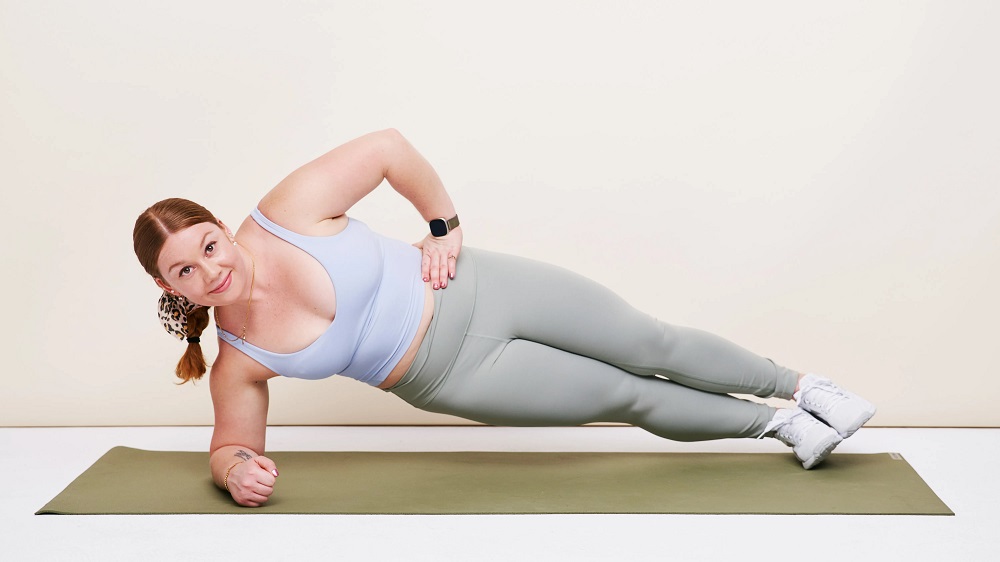
Side Plank: Lie on your side with your elbow directly beneath your shoulder and your legs stacked or staggered for added stability. Lift your hips toward the ceiling until your body forms a straight diagonal line from head to feet. Maintain tension in your lower oblique, glutes, and shoulder stabilizers without allowing your top hip to roll forward. Hold for twenty to forty seconds per side.
-
Single-Arm Suitcase Carry: Pick up a heavy dumbbell or kettlebell in one hand while standing tall with feet hip-width apart. Walk forward at a measured, deliberate pace for a set distance or time, keeping your shoulders level and your torso perfectly upright. Resist the weight’s attempt to pull your torso into a side bend. Switch hands and repeat the walk on the opposite side.
Anti-Rotation Exercises
Anti-rotation movements build profound stability across the obliques and transverse abdominis by challenging the core to resist twisting forces.
-
Pallof Press: Stand perpendicular to a cable column or a resistance band anchored at chest height. Grasp the handle with both hands and step away until you feel moderate tension. Position your feet shoulder-width apart with soft knees, hold your hands close to your sternum, and press your arms straight forward. Hold the fully extended position for two seconds while actively fighting the band’s rotational pull, then smoothly return your hands to your chest.
-
Bird-Dog: Begin on all fours with your wrists directly beneath your shoulders and knees under your hips. Brace your midsection to lock your pelvis in neutral. Simultaneously reach your right arm straight forward and kick your left leg straight back until both are parallel to the floor. Focus on minimizing any rotational shifting in your hips and torso. Hold for three seconds, return to the start, and alternate sides.
Dynamic Integration and Hip-Hinge Patterns
Dynamic patterns combine core stability with functional whole-body coordination, integrating the hips and upper back into athletic movement.
-
Farmer’s Walk: Hold two equally heavy dumbbells or kettlebells at your sides, maintain an upright posture with shoulders retracted and chest tall, and walk with short, deliberate strides. This classic loaded carry trains full-body postural endurance, grip strength, and deep core stiffness.
-
Hanging Knee or Leg Raise: Hang from a pull-up bar with an overhand grip, engaging your lats to stabilize your shoulder joints. Without swinging or using momentum, contract your abdominals to bring your knees toward your chest, or keep your legs straight for increased resistance. Lower down slowly to avoid relying on gravity.
Sample Weekly Core Integration Template
To achieve optimal muscular adaptation without overtraining, integrate core movements into your current exercise routine across three dedicated sessions per week.
| Day | Focus Category | Primary Exercise | Sets and Reps or Time | Secondary Exercise | Sets and Reps or Time |
| Day 1 | Anti-Extension and Isometric | Forearm Plank | 3 sets of 30 seconds | Deadbug | 3 sets of 10 reps per side |
| Day 2 | Anti-Rotation and Spinal Control | Pallof Press | 3 sets of 12 reps per side | Bird-Dog | 3 sets of 8 reps per side |
| Day 3 | Anti-Lateral Flexion and Loaded Carry | Suitcase Carry | 3 sets of 40 paces per side | Side Plank | 3 sets of 30 seconds per side |
Frequently Asked Questions
Can children and teenagers safely perform dedicated core strengthening exercises?
Yes, core strengthening is completely safe and highly beneficial for young individuals when focused on bodyweight stabilization movements like bird-dogs, planks, and deadbugs. These exercises teach foundational body control and protect young spines during sports, provided excessive external spinal loading is avoided until proper movement mechanics are mastered.
How does breath control influence core activation during heavy lifting?
Breathing dictates intra-abdominal pressure, which is the internal pneumatic force supporting the lumbar spine. Utilizing the Valsalva maneuver, where you inhale deeply into the diaphragm and brace against a closed glottis before lifting, creates an internal cushion that prevents spinal flexion under heavy loads such as squats and deadlifts.
Does performing core exercises burn enough calories to eliminate abdominal fat?
Spot reduction of fat is physiologically impossible because the human body metabolizes stored adipose tissue systemically rather than locally. While core exercises strengthen and hypertrophy the underlying abdominal muscles, revealing those muscles requires a consistent caloric deficit achieved through nutrition and overall energy expenditure.
Why do some individuals experience hip flexor fatigue instead of abdominal fatigue during core work?
When the transverse abdominis and rectus abdominis lack sufficient strength or motor coordination, the brain compensates by over-recruiting the psoas and rectus femoris muscles to stabilize the pelvis. This commonly occurs during leg lifts and sit-ups when the lower back arches off the floor, transferring the mechanical load from the core to the hip joints.
How do seated office workers modify core exercises if they have tight hamstrings?
Tight hamstrings frequently tilt the pelvis backward when lying down or bending forward, placing unwanted stress on the lumbar region. Desk workers should perform floor exercises like the deadbug with knees bent at ninety degrees rather than extended, or focus on standing anti-rotation movements like the Pallof press that keep the hamstrings in a comfortable, neutral position.
What is the primary difference between core strength and core endurance?
Core strength refers to the maximum amount of force the abdominal and spinal muscles can generate or resist during a single short-duration effort, such as a maximum barbell squat. Core endurance is the capacity of these stabilizing muscles to sustain submaximal tension over extended periods, which is far more critical for preventing lower back pain and maintaining proper posture throughout the day.
