

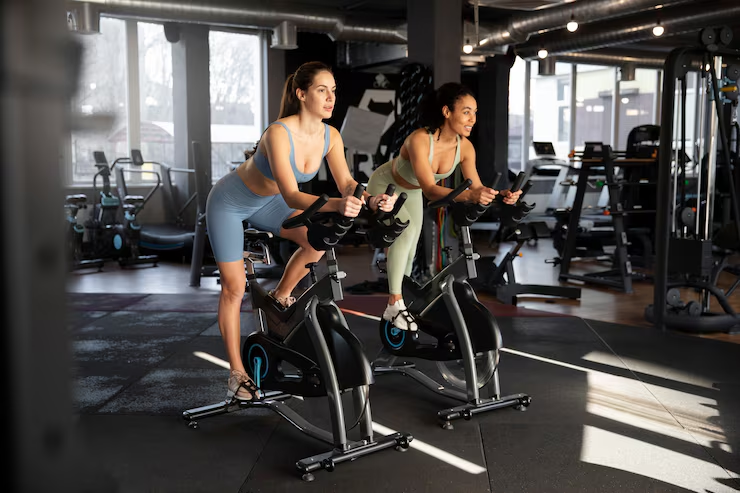
Zone 2 training has moved from a concept understood mainly by endurance athletes into mainstream fitness conversation, and for good reason. The physiological adaptations it produces, enhanced mitochondrial density, improved fat oxidation efficiency, and cardiovascular base development, are directly relevant to a wide range of fitness goals well beyond competitive sport.
For Singapore athletes and serious fitness members, the spin bike has emerged as one of the most practical and controllable tools for implementing Zone 2 protocols. Indoor cycling Singapore sessions structured around Zone 2 principles offer a form of training that many members are genuinely missing from their current approach, and the results over a 12 to 16 week implementation are consistently significant.
What Zone 2 Actually Means
Heart rate training zones divide exercise intensity into five levels based on the percentage of maximum heart rate. Zone 2 typically sits at 60 to 70 percent of maximum heart rate, roughly the intensity where you can hold a conversation but feel that breathing requires a little more deliberate management.
At this intensity, the body preferentially uses fat as its primary fuel source and relies heavily on the aerobic energy system. The mitochondria, which are the cellular structures responsible for aerobic energy production, adapt to Zone 2 training by increasing in number and efficiency. This is the defining adaptation of Zone 2 work and the foundation of almost all endurance performance development.
More precisely, Zone 2 is often defined by lactate threshold: the intensity at which blood lactate levels are just beginning to rise above baseline, typically around 1.5 to 2 millimoles per litre. This can be assessed precisely in a performance laboratory, but heart rate provides a practical proxy for most athletes and fitness members outside of a clinical setting.
Why the Spin Bike Is Ideal for Zone 2
Zone 2 training requires sustained, steady-state effort at a controlled intensity for extended durations, typically 45 to 90 minutes per session. This is where the spin bike offers significant practical advantages over other modalities.
Resistance is infinitely adjustable and immediately responsive. If your heart rate drifts above Zone 2 on a bike, you reduce resistance slightly and return to the target zone within seconds. On a treadmill, adjusting speed creates abrupt changes; outdoors, terrain variation makes sustained zone maintenance genuinely difficult.
The non-impact nature of cycling also means that Zone 2 sessions of 60 to 90 minutes are far less physically taxing in terms of joint stress and recovery demand than equivalent duration running. Athletes can accumulate higher Zone 2 volume on a spin bike without the cumulative impact load that running produces.
The Singapore-Specific Case for Zone 2
Singapore’s outdoor training environment creates genuine obstacles for Zone 2 work. Heat and humidity elevate heart rate above what ambient conditions would produce in a temperate climate, making Zone 2 heart rate targets difficult to maintain outdoors without significantly reducing pace. A heart rate that would correspond to Zone 2 effort in a cool environment will be reached at a much lower physical output in Singapore’s heat.
The air-conditioned spin studio solves this problem directly. Controlled temperature and humidity means that heart rate truly reflects metabolic effort rather than thermoregulatory demand. Zone 2 protocols conducted on an indoor bike in Singapore are more precise and more reproducible than equivalent outdoor efforts in the heat.
A Practical Zone 2 Protocol for Spin Sessions
A standard Zone 2 spin protocol for Singapore athletes follows this structure:
- Warm-up: 10 minutes at low resistance, building gradually to the lower edge of Zone 2
- Main block: 35 to 60 minutes at steady Zone 2 effort, adjusted through resistance to maintain heart rate within the target range
- Cooldown: 10 minutes at progressively reduced resistance, returning heart rate to resting range
During the main block, cadence typically sits between 80 and 95 RPM at a resistance level that makes maintaining that cadence feel moderately demanding but sustainable. Talking during this phase should be possible in short sentences.
How to Integrate Zone 2 Into a Weekly Training Programme
Zone 2 sessions sit alongside rather than replace higher intensity training. A well-structured weekly programme might include two Zone 2 spin sessions of 45 to 60 minutes each, one or two higher intensity conditioning or interval sessions, and two to three resistance training sessions.
Zone 2 work develops the aerobic base that makes higher intensity training more productive. Athletes who add consistent Zone 2 volume over 12 to 16 weeks typically find that their high-intensity training sessions improve significantly because the underlying aerobic engine has been developed.
FAQ
How do I calculate my Zone 2 heart rate without a laboratory test?
A practical estimate is 60 to 70 percent of your maximum heart rate. For a rough maximum heart rate estimate, subtract your age from 220. This is an approximation and individual variation is significant, but it provides a reasonable starting point. The talk test is a useful real-time check: if you can speak in full sentences without pausing for breath, you are likely within Zone 2.
Can I do Zone 2 training in a standard group spin class?
Most group spin classes are structured around higher intensity intervals rather than sustained Zone 2 effort. Zone 2 sessions are better conducted as individual efforts on a spin bike with a heart rate monitor, rather than in a class environment where the programming is designed for different training outcomes.
How long before I notice results from Zone 2 training?
Mitochondrial adaptations from Zone 2 training are measurable within 4 to 6 weeks but become most pronounced over a 12 to 16 week period of consistent training. Early indicators include improved effort economy at the same heart rate and the ability to sustain Zone 2 effort for longer durations without heart rate drift.
Is Zone 2 training suitable for beginners?
Zone 2 is among the most appropriate training intensities for beginners because it is sustainable, produces genuine adaptation, and creates minimal injury risk. The challenge for beginners is that their aerobic fitness may be low enough that Zone 2 effort feels relatively hard initially. This improves rapidly with consistent practice.
TFX Singapore provides spin bikes with performance monitoring capabilities that make implementing Zone 2 protocols straightforward, with instructors who can guide members on how to integrate this type of training into their broader programme.
